The Defense of Taiwan — It’s About Individual Rights, Stupid!

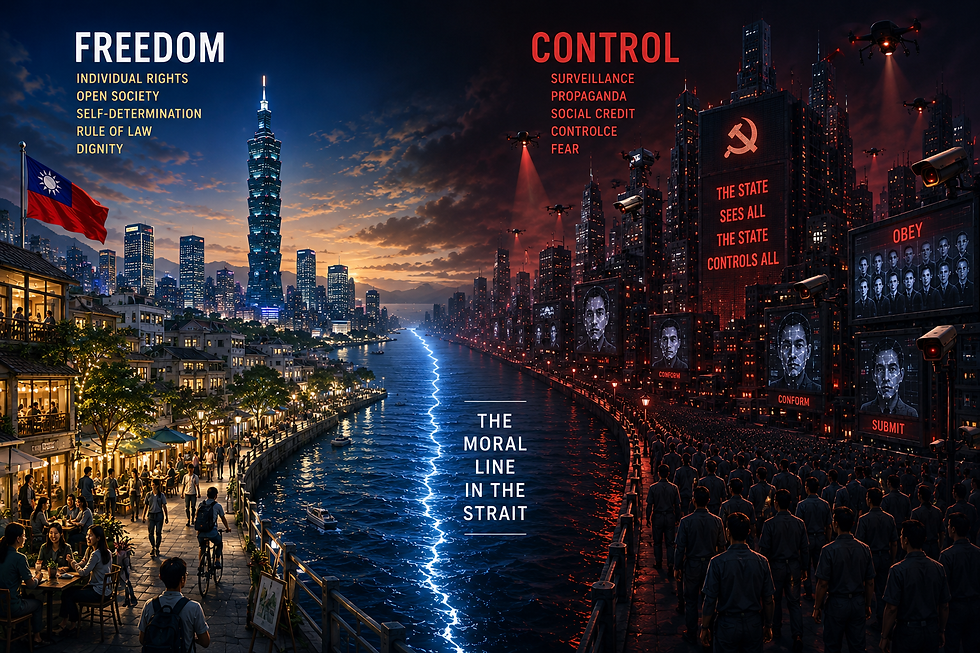
Donald Trump says America’s Taiwan policy has not changed. In one narrow diplomatic sense, perhaps that is true. But foreign policy is not made by formulas alone; it is made by signals, emphases, hesitations, omissions, and moral commitments. When the president of the United States discusses Taiwan’s defense with Xi Jinping, refuses to commit clearly to arms sales, and speaks as if Taiwan’s survival were merely another item in a negotiation with Beijing, the words matter. Policy may remain formally intact while its moral and strategic meaning is quietly drained away.
The immediate issue is Trump’s recent uncertainty over arms sales to Taiwan. Reuters reported that Trump discussed U.S. arms sales to Taiwan with Xi Jinping during talks in Beijing and said he would soon make a decision on the matter. Reuters also reported that Taiwan responded by stressing that U.S. arms sales are a “cornerstone” of regional peace and stability, while a further arms package of roughly $14 billion remains unresolved. Taiwan’s government, in that context, specifically invoked the Taiwan Relations Act as the legal and security framework under which the United States assists Taiwan’s self-defense.
That legal point is crucial. The Taiwan Relations Act does not create an automatic treaty obligation requiring the United States to go to war in every possible Taiwan contingency. But it also does not leave Taiwan’s defense to presidential whim, personal mood, or deal-making theatrics. The Act states that it is U.S. policy “to provide Taiwan with arms of a defensive character” and “to maintain the capacity of the United States to resist any resort to force or other forms of coercion” that would jeopardize the security, social system, or economic system of the people on Taiwan.
The Act goes further. It says that the United States will make available to Taiwan such defense articles and services “as may be necessary” to enable Taiwan to maintain a sufficient self-defense capability. It also directs that the President and Congress determine the nature and quantity of those defense articles and services based on their judgment of Taiwan’s defense needs. The President is further directed to inform Congress promptly of threats to Taiwan’s security or social and economic system, after which the President and Congress are to determine the appropriate response through constitutional processes.
This means we should be precise. Trump’s remarks are not “treason” in the strict constitutional sense, and the Taiwan Relations Act is not a formal mutual-defense treaty. But the Act does codify a durable American legal commitment to Taiwan’s self-defense, to resistance against coercion, and to the preservation of Taiwan’s human rights. A president who treats arms to Taiwan as a disposable bargaining counter with Xi Jinping may not have violated the letter of the Act merely by speaking carelessly; he has nevertheless shown contempt for its spirit, its purpose, and the moral reality it was meant to address.
That moral reality is the real subject. Taiwan is not merely a “flashpoint” in U.S.-China relations. It is not merely a semiconductor hub, a naval outpost, a democratic irritant, or a strategic asset in the First Island Chain. Taiwan is a free, self-governing society of individuals who think, produce, speak, trade, dissent, vote, build businesses, raise families, and live under institutions that, however imperfectly, protect their freedom. The basic question is not whether Taiwan is useful to America. The basic question is whether twenty-three million human beings may live their own lives without being absorbed by a communist dictatorship.
That is why the defense of Taiwan is about individual rights. It is not about preserving an abstract “rules-based order” whose rules no one can name. It is not about indulging American prestige or proving that Washington remains the world’s policeman. It is not, fundamentally, about chips, shipping lanes, or great-power prestige, although all of these matter. It is about whether men and women are the property of the state.
China’s claim over Taiwan is not merely a cartographic claim. It is a claim of political ownership over human lives. It is the assertion that the Chinese Communist Party has the right to command people who do not consent to its rule, regulate their speech, direct their associations, control their property, punish their dissent, and absorb their future into the machinery of one-party rule. That is not a “territorial dispute” in the morally neutral sense. It is a proposed act of mass subjugation.
There is no moral symmetry here. Taiwan is not threatening to invade China. Taiwan is not sending warships and aircraft to compel Beijing’s surrender. Taiwan is not demanding that the Chinese people submit to Taipei. The threat comes from the dictatorship that insists that a free society has no right to exist beyond its control.
This is why Trump’s anti-intellectuality matters. The issue is not that he fails to speak in the polished language of diplomatic professionals. Often that language conceals more than it clarifies. The problem is deeper: Trump does not think in principles. He thinks in leverage, price, burden, distance, grievance, personality, flattery, threat, and deal structure.
This is not realism. Realism begins with reality, and reality requires identification. A free society is not a dictatorship. A victim is not an aggressor. Defensive arms are not a provocation. A legal commitment is not a mood. Rights are not bargaining counters.
Trump’s amoralism is especially dangerous because he reduces moral and strategic questions to commercial metaphors. In 2024, he said Taiwan should pay the United States for defense, claimed that Taiwan had taken almost all of America’s chip business, and described the United States as “no different than an insurance company.” That was not an isolated rhetorical flourish. It was a glimpse into a mind that sees a free society under threat as if it were a delinquent client negotiating a protection contract.
Of course Taiwan should do more for its own defense. A people that wants to remain free must be willing to bear the burdens of freedom. Defense spending, reserve readiness, civil resilience, cyber security, energy security, and national will are not optional gestures. They are the practical expression of a society’s refusal to be ruled.
But Taiwan’s obligation to defend itself does not erase the moral meaning of China’s threat, nor does it erase the legal structure of American policy. The Taiwan Relations Act does not say that America will assist Taiwan only if a president finds the island sufficiently grateful or profitable. It does not say that Taiwan’s defense needs are to be determined by Xi Jinping’s irritation. It says that Taiwan’s self-defense capability matters as a standing objective of American law.
This is where Trump’s language becomes more than vulgarity. A president swears to faithfully execute the laws of the United States. That duty does not require him to promise war recklessly, but it does require him to treat statutory commitments with seriousness. When he speaks of Taiwan’s defense as if it were an optional favor, a line item, or a bargaining chip, he undermines not only deterrence but the constitutional seriousness of his own office.
The problem is not only Trump. He is the crude expression of a wider Western failure. For decades, the foreign-policy class has discussed Taiwan in the language of stability while avoiding the language of rights. The business class has discussed Taiwan in the language of supply chains while avoiding the language of freedom. The strategic class has discussed Taiwan in the language of deterrence while too often evading the moral reason deterrence is necessary.
Trump strips away the varnish. Where others say “strategic ambiguity,” he says he may or may not proceed. Where others say “burden sharing,” he says Taiwan should pay. Where others hide evasion inside white papers, he blurts it out as instinct. That is why his remarks are useful, even as they are dangerous: they expose the premise that Taiwan’s freedom is negotiable.
The Objectivist answer to that premise begins with a simple chain of thought. Man lives by reason. Reason cannot function under coercion. A human being forced to act against his judgment is not merely inconvenienced; his basic means of survival has been attacked. Rights are the moral principles that protect the individual’s freedom to think, act, produce, trade, and live by his own judgment in a social context.
This is why dictatorship is evil. It is not evil merely because it is inefficient, although it often is. It is not evil merely because it produces fear, censorship, poverty, corruption, and stagnation, although it does. It is evil because it institutionalizes the subordination of the individual mind to state force. It turns the citizen into a subject and the subject into material.
A free society is morally superior to a dictatorship because it recognizes, in law and practice, that the individual is not a sacrificial animal. He does not exist for the party, the race, the nation, the tribe, the emperor, the chairman, or the state. He exists for his own life. Government is proper only when it protects the individual from force, not when it becomes the chief instrument of force.
By that standard, Taiwan and Communist China are not equivalent claimants in a technical dispute. Taiwan, with all its imperfections, is a society in which individuals possess substantial freedom to think, speak, trade, criticize, and govern themselves. China is a one-party dictatorship that claims the right to rule those same individuals by force. To evade that distinction is not sophistication. It is moral cowardice.
This is also why the semiconductor argument, though important, must not become central. If Taiwan produced no chips, its people would still have rights. If its factories were less valuable, China would still have no right to conquer it. If the world could replace every chip fabricated in Taiwan tomorrow, the forcible subjugation of Taiwan would still be an evil.
The chip argument is useful strategically, but it is dangerous morally when treated as primary. It tells Beijing that the value of a free society can be calculated by inventory. It tells Americans that liberty matters only when it is profitable. It tells the Taiwanese that their freedom is an externality of industrial policy. That is not a defense of Taiwan. It is an appraisal of Taiwan, and appraisals can change.
A rights-based defense is different. It says that no ruler in Beijing has the moral authority to acquire title to human beings by drawing historical lines on a map. It says that a free people may defend themselves because their lives belong to them. It says that America’s interest in Taiwan is not charity, sentimentality, or imperial vanity, but the rational interest of a free country in a world where aggression is deterred and free societies are not casually abandoned to dictatorships.
This is the proper meaning of national interest. A nation should not sacrifice its citizens to unlimited global crusades. It should not treat every conflict as its own. It should not confuse moral judgment with automatic military intervention. But neither should it define national interest as a cash transaction, stripped of principle, context, and long-range consequences.
It is in the rational interest of free societies that dictatorships learn conquest is costly. It is in the rational interest of free societies that productive, rights-respecting societies are not swallowed by militarized slave states. It is in the rational interest of free societies that aggression not be rewarded by hesitation, flattery, and transactional ambiguity. A world in which Taiwan can be coerced into submission is not a safer world for America or any other free country.
Nor is moral clarity the same as recklessness. To say that China has no right to conquer Taiwan is not to say that America must promise automatic war in every scenario. To say that Taiwan has the right to defend itself is not to say that the United States should act without regard to costs, capabilities, escalation risks, geography, logistics, or the lives of its own citizens. A rational foreign policy does not float above facts. It integrates moral principle with strategic reality.
The rational policy is principled deterrence. Taiwan should be armed before a crisis, not pitied after one. The United States should make available the defensive weapons needed to make invasion prohibitively costly, in accordance with the purpose of the Taiwan Relations Act. Regional allies should coordinate seriously, not merely issue statements of concern after each Chinese provocation. Washington should stop treating Beijing’s anger as if it were a veto over Taiwan’s survival.
Deterrence requires weapons, but it also requires moral confidence. Beijing watches aircraft carriers and missile inventories, but it also watches language. It studies hesitation. It notices whether Taiwan is described as a free society or as a problem. It notices whether arms sales are treated as lawful instruments of defense or as chips in a negotiation with Xi Jinping.
This is where “strategic ambiguity” can decay into moral ambiguity. Strategic ambiguity, at its best, is meant to keep Beijing uncertain about the military consequences of aggression. Moral ambiguity does something else entirely. It makes Taiwan uncertain whether its freedom is recognized as a value at all. It makes China suspect that pressure, patience, and flattery may succeed where invasion would be costly.
The United States need not say everything it would do in every contingency. But it must be clear about the moral and legal premises from which it acts. China has no right to determine Taiwan’s future by force. Taiwan has the right to maintain a sufficient self-defense capability. The United States has codified its interest in providing defensive arms and maintaining the capacity to resist coercion. These are not casual preferences; they are the foundation of any serious Taiwan policy.
Trump’s recent posture endangers that foundation because it treats the issue as personal and transactional. He may not have repealed the policy. He may not have violated the Taiwan Relations Act in any narrow legal sense. But he has spoken in a way that makes a statutory commitment sound like a negotiable favor. For a president sworn to execute the laws, that is not a small defect.
The defenders of this posture will call it flexibility. But flexibility without principle is not strategy; it is drift. They will call it deal-making. But a deal over another people’s freedom is not statesmanship; it is moral evasion. They will call it realism. But there is nothing realistic about refusing to identify the nature of the regime threatening Taiwan or the nature of the society being threatened.
Ayn Rand argued that a culture needs intellectuals because it needs men who can identify principles, integrate events, and give voice to values. That point applies with unusual force here. Taiwan is not only testing American military readiness. It is testing whether the free world still has the intellectual capacity to name what it sees. A society that cannot say why freedom is morally superior to tyranny will eventually lack the will to defend freedom against tyranny.
The defense of Taiwan therefore requires more than military hardware. It requires moral identification. It requires saying that China’s threat is not an unfortunate misunderstanding, not an emotional quarrel, not a symmetrical dispute, and not merely a challenge to American influence. It is the threat of force against a free people.
Once that fact is named, the practical questions become clearer rather than harder. How should Taiwan be armed? How should the United States deter China without recklessness? How should Japan, Australia, India, the Philippines, and other regional actors understand the stakes? How should supply chains be secured without reducing Taiwan to a factory island? These are serious questions, but they must be asked after the moral fact has been grasped.
The moral fact is that the people of Taiwan have the right to their own lives. China has no right to take those lives over. No American president has the right to treat that issue as a private bargaining chip. And no defender of freedom should allow the language of “stability” to become a euphemism for appeasement.
Taiwan is not ours to trade. It is not Beijing’s to own. It belongs morally and politically to the individuals who live there, because their lives belong to them.
That is the issue.
The defense of Taiwan is about individual rights, stupid.


